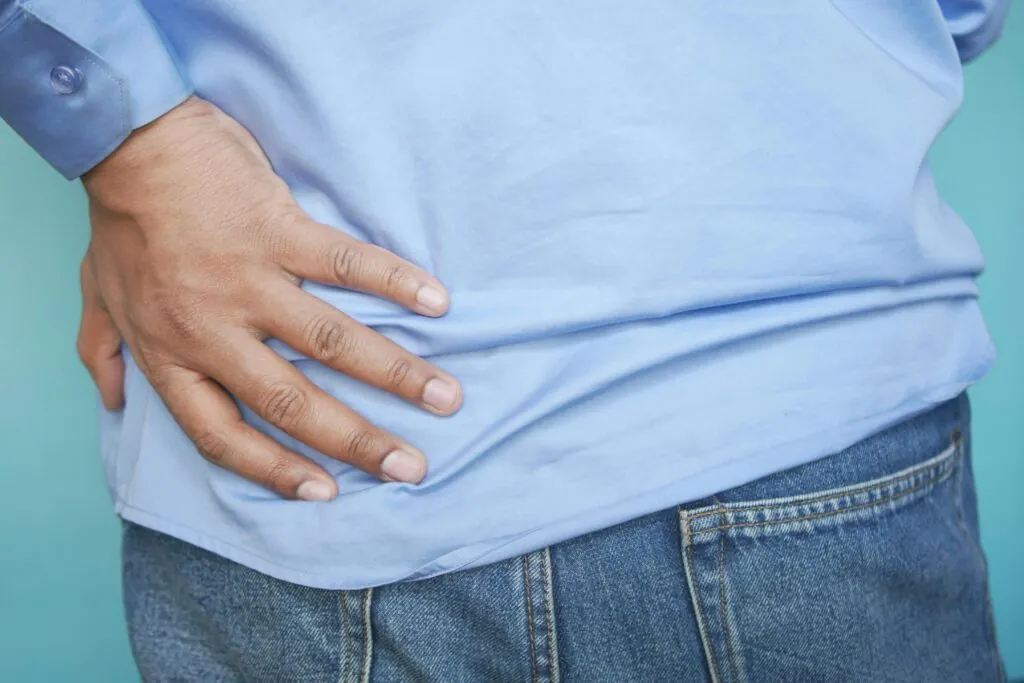
Can you pinpoint your buttock pain with a single finger? Pain localised to the ischial tuberosity or “sit bone” often indicates proximal hamstring tendinopathy. This condition develops gradually through repetitive loading rather than a sudden strain. It is especially common among runners, cyclists, and those with sedentary jobs.
The hamstring group consists of three muscles that attach to the sit bone through a shared conjoint tendon. When this area undergoes repeated stress without recovery, the collagen fibres become disorganised, and the tendon thickens. This structural change is known as tendinosis because inflammation is rarely the primary cause in chronic cases. Recognising proximal hamstring tendinopathy early allows for more effective conservative management.
Anatomy of the Proximal Hamstring Attachment
The ischial tuberosity serves as the anchor point for the hamstring tendons. It sits at the lower part of the pelvis. When you sit, your body weight compresses directly onto this structure.
The conjoint tendon—where semitendinosus and biceps femoris merge—bears high mechanical load. The semimembranosus attaches separately but in close proximity. This anatomical arrangement means that tendinopathy can affect one or multiple tendons simultaneously.
Relationship to Surrounding Structures
The sciatic nerve is the large nerve that runs down the back of your leg. It sits immediately adjacent to the proximal hamstring attachment. Tendon swelling can irritate this nerve and produce radiating symptoms down the back of the thigh. This often mimics sciatica. The ischial bursa is a fluid-filled sac that cushions the space between the tendon and bone. This sac may also become inflamed and contribute to localised pain.
Causes and Risk Factors
Proximal hamstring tendinopathy results from an imbalance between tendon loading and recovery capacity. Several factors increase vulnerability to this condition.
Running biomechanics significantly influence tendon stress. Overstriding—landing with the foot too far in front of the body—increases hamstring load during the stance phase (when your foot is in contact with the ground). Hill running and speed work place additional demands on the proximal attachment.
Sudden training changes trigger many cases. Rapid increases in running distance, introduction of hill repeats, or adding sprint intervals without gradual progression overwhelm the tendon’s adaptive capacity.
Prolonged sitting creates compressive load on the tendon against the ischial tuberosity. Office workers who also engage in running or cycling face combined compressive and tensile stresses throughout the day.
Hip muscle weakness, particularly in the gluteus maximus and medius (the large muscles in your buttocks that help stabilise your hips), forces the hamstrings to compensate during activities requiring hip extension and stability.
Age-related changes reduce tendon vascularity (blood supply) and collagen quality.
Recognising the Symptoms
Proximal hamstring tendinopathy produces a characteristic pattern of symptoms that distinguishes it from other causes of buttock and posterior thigh pain.
- Location: Deep, localised pain at the ischial tuberosity—the “sit bone.” Patients can typically pinpoint the spot with one finger.
- Sitting intolerance: Pain worsens with prolonged sitting, particularly on hard surfaces. Many individuals shift weight to one side or stand frequently to relieve discomfort.
- Activity-related pain: Running, lunging, climbing stairs, and deadlifting (a weightlifting exercise where you lift a weight from the floor) aggravate symptoms. Pain often increases with higher speeds or longer distances rather than appearing immediately.
- Stiffness pattern: Morning stiffness or increased discomfort after periods of inactivity improves with gentle movement but returns with sustained activity.
- Radiating discomfort: Some individuals experience aching down the back of the thigh, though this rarely extends below the knee unless sciatic nerve irritation is present.
💡 Did You Know?
The hamstring tendons can withstand forces many times body weight during sprinting. This load-bearing capacity also means that recovery from tendinopathy requires progressive loading rather than complete rest.
Diagnostic Approaches
Accurate diagnosis of proximal hamstring tendinopathy involves clinical assessment and often imaging confirmation to rule out other conditions and confirm tendon changes.
Clinical Examination
Physical examination reveals tenderness directly over the ischial tuberosity. One common assessment involves resisted knee flexion with the hip extended to reproduce the pain. This occurs when a practitioner asks you to bend your knee against resistance. Another diagnostic tool is the Puranen-Orava test.
During this test, the practitioner performs passive hip flexion while keeping the knee straight. This movement stretches the affected area to confirm the source of discomfort. Gentle pressing during these movements helps localise symptoms to the specific tendon attachment.
Healthcare providers assess hip strength, flexibility, and running biomechanics to identify contributing factors that require addressing during rehabilitation.
Imaging Studies
MRI (Magnetic Resonance Imaging) provides detailed visualisation of tendon structure. It reveals thickening, signal changes indicating tendinosis, and partial tears. MRI also identifies or excludes other pathologies, including ischial bursitis (inflammation of the cushioning sac), stress fractures (tiny cracks in bone from overuse), and sciatic nerve abnormalities.
Ultrasound offers a dynamic assessment option. It allows examination during muscle contraction. Experienced practitioners can identify tendon swelling, neovascularisation (new blood vessel growth often associated with chronic tendon problems), and cortical irregularities (changes in the bone surface) at the ischial tuberosity.
Imaging findings must correlate with clinical presentation, as asymptomatic tendon changes exist in active individuals.
Conservative Treatment Strategies
Many proximal hamstring tendinopathy cases respond to comprehensive conservative management over several months.
Load Management
Initial treatment involves modifying aggravating activities rather than complete rest. Reducing running volume, avoiding hill work, and limiting prolonged sitting preserve tendon loading capacity whilst preventing further breakdown.
For runners, this may mean a temporary transition to cycling or swimming—activities that maintain cardiovascular fitness whilst reducing hamstring tendon stress. Complete cessation of activity leads to tendon deconditioning.
Progressive Tendon Loading
Controlled loading supports tendon remodelling (the process by which damaged tendon tissue is repaired and strengthened) and strengthens the attachment site. Exercise progression follows a systematic approach:
- Isometric exercises involve sustained muscle contractions without movement. These exercises begin the rehabilitation process. Bridge holds with knees bent at a right angle are a common starting point. This position loads the proximal hamstrings without creating significant compression at the sit bone.
- Isotonic strengthening follows as the next phase of rehabilitation. This involves exercises that move the muscle through a specific range of motion. Key movements include Romanian deadlifts, where you hinge at the hips while keeping your legs mostly straight. You may also perform Nordic curls, which is a kneeling exercise where you slowly lower your body forward.
- Energy storage exercises prepare the tendon for return to running. Lunges, single-leg deadlifts, and eventually bounding movements challenge the tendon’s capacity to store and release energy.
Addressing Contributing Factors
Hip strengthening targets the gluteus maximus and medius weakness. Clamshells (a side-lying exercise where you open your top knee like a clamshell), lateral band walks (stepping sideways against resistance), and single-leg stance exercises build stability that helps reduce hamstring compensation.
Hamstring flexibility work requires caution. Aggressive stretching compresses the tendon against the ischial tuberosity and may aggravate symptoms. Gentle, pain-free stretching in later rehabilitation phases maintains flexibility without irritating the attachment.
⚠️ Important Note
Avoid sitting directly on the affected area during recovery. Use a cushion with a cut-out section over the ischial tuberosity or alternate between sitting and standing throughout the day.
Advanced Treatment Options
When conservative measures prove insufficient after several months, additional interventions may be considered. An orthopaedic surgeon can determine the appropriate approach based on your specific situation and response to initial treatment.
Injection Therapies
Corticosteroid injections (injections containing anti-inflammatory medication) can provide temporary pain relief but do not address underlying tendon pathology. Repeated injections may weaken tendon structure and are generally discouraged for long-term management.
Platelet-rich plasma (PRP) injections deliver concentrated growth factors (proteins that promote healing) from your own blood to the tendon. Response differs among patients, with some experiencing meaningful improvement whilst others show minimal benefit.
High-volume image-guided injections aim to strip neovascularisation from the tendon, potentially reducing pain signalling. This technique requires ultrasound guidance and specialised training.
Shockwave Therapy
Extracorporeal shockwave therapy applies acoustic waves (high-energy sound waves) to the affected tendon. Treatment typically involves multiple sessions over several weeks, combined with ongoing rehabilitation exercises.
Surgical Intervention
Surgery becomes relevant for cases unresponsive to comprehensive conservative management over an extended period. Procedures include removal of damaged tendon tissue, release of the conjoint tendon, and repair of partial tears.
Post-surgical rehabilitation follows similar principles to conservative management but with longer timeframes for return to full activity—typically a significant period depending on the procedure performed.
Return to Running Guidelines
Return to running requires systematic progression based on symptom response rather than arbitrary timelines.
- Phase 1: Walk-run intervals beginning with short running segments separated by walking. Initial sessions might include several repetitions of brief running with walking recovery.
- Phase 2: Continuous easy running on flat terrain, gradually increasing duration whilst monitoring symptoms. Running should remain below moderate intensity.
- Phase 3: Introduction of varied terrain and pace, including gentle hills and tempo efforts. Speed work returns last, as sprinting places high demands on the proximal hamstring attachment.
Progression criteria: No more than mild discomfort during running that resolves within a day. Any increase in resting symptoms or morning stiffness indicates excessive loading.
✅ Quick Tip
Shorten your running stride by increasing cadence (the number of steps you take per minute). Taking more frequent, smaller steps can reduce hamstring load during the stance phase and decrease stress on the proximal attachment.
Putting This Into Practice
- Modify your workspace: Standing desks, regular movement breaks, and cushioned seating reduce compressive load on the ischial tuberosity during work hours.
- Warm up appropriately: Dynamic movements (exercises involving active movement), including leg swings, walking lunges, and light jogging, prepare hamstring tendons for activity better than static stretching (holding a stretch in one position).
- Monitor training load: Track weekly running distance and intensity. Limit increases to modest amounts each week, allowing the tendon to adapt progressively.
- Maintain strength training: Continue hamstring and hip strengthening exercises even after symptoms resolve. Ongoing conditioning helps prevent recurrence.
- Address footwear: Appropriate running shoes and timely replacement can reduce biomechanical stress throughout the kinetic chain (the connected system of body parts involved in movement).
When to Seek Professional Help
- Pain at the ischial tuberosity persists beyond several weeks despite activity modification
- Inability to sit comfortably for routine daily activities
- Symptoms preventing participation in exercise or sport
- Weakness in the hamstring or difficulty with stairs and inclines
- Radiating pain down the back of the thigh
- Previous hamstring injury at the same site
- Symptoms not responding to self-directed rehabilitation
Commonly Asked Questions
How long does proximal hamstring tendinopathy take to heal?
Recovery typically spans several months with appropriate management, though chronic cases may require longer. Tendons adapt slowly to loading.
Can I continue running with proximal hamstring tendinopathy?
Continuation depends on symptom severity. Mild cases may tolerate reduced running volume at an easy pace. Moderate to severe cases benefit from a temporary transition to non-aggravating activities.
What’s the difference between hamstring tendinopathy and a hamstring strain?
Hamstring strains occur suddenly during forceful movements (such as sprinting or jumping). They cause immediate pain and often bruising in the muscle belly. Tendinopathy develops gradually with pain localised to the tendon attachment at the ischial tuberosity. Treatment approaches differ significantly between these conditions.
Does stretching help proximal hamstring tendinopathy?
Aggressive stretching typically aggravates symptoms by compressing the tendon against the bone. Gentle, pain-free stretching may be incorporated in later rehabilitation phases. However, progressive strengthening exercises can provide benefits for tendon recovery.
Will the pain go away on its own?
Without appropriate management, symptoms often persist or worsen. The tendon requires controlled loading to support repair. Complete rest or continued aggravating activity both delay recovery. Structured rehabilitation offers a path to resolution.
Important Disclaimer: Individual recovery experiences and treatment responses will differ due to personal health factors, condition severity, and adherence to rehabilitation protocols. The information provided here is educational and should not replace personalised medical advice. Always consult qualified healthcare professionals for assessment and treatment recommendations tailored to your specific circumstances.
Next Steps
Early intervention combining load modification, progressive strengthening, and addressing contributing factors offers the most effective path to recovery. A professional assessment can confirm the diagnosis and guide rehabilitation tailored to your activity goals.
If you’re experiencing persistent pain at the base of your buttocks that worsens with sitting, running, or climbing stairs, consult an orthopaedic surgeon to evaluate your condition and discuss treatment options.